Government leaders call for treaty negotiations on autonomous weapons to begin in November
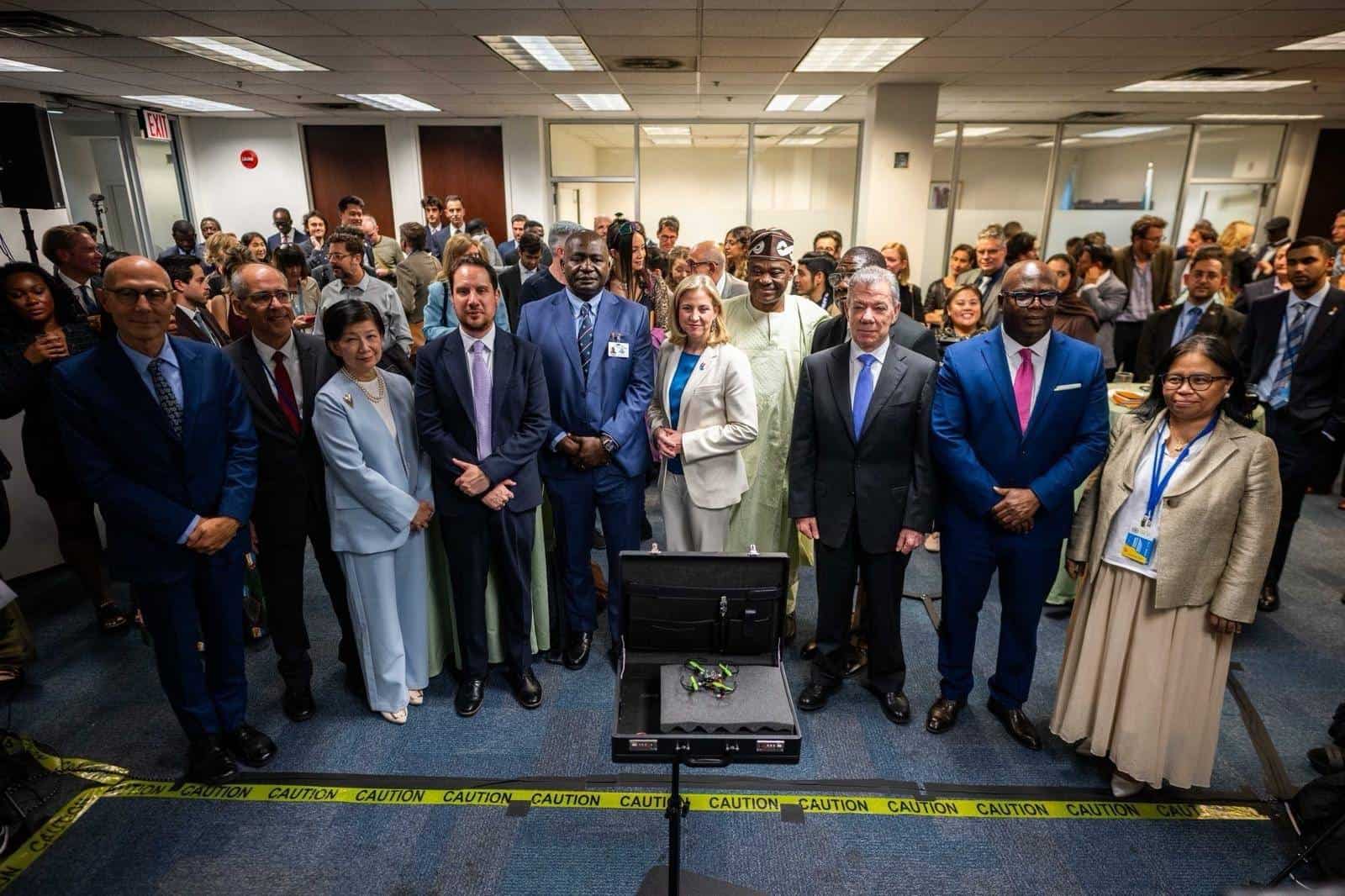
On Wednesday, 23 September in New York, during the UN General Assembly’s High-Level Week, ministers and other senior representatives from government, international organisations, civil society and the press gathered at Nigeria House to explore the urgency of this issue and the need for immediate action, at an unprecedented forum cosponsored by the governments of Nigeria, Austria, Belgium, Brazil, Mexico, and the Philippines, the UN Human Rights Office (OHCHR), the International Committee of the Red Cross, The Elders and the Future of Life Institute.
“States have agreed on elements for a future instrument. We should not waste that progress. The CCW Review Conference in November must now decide to begin negotiations,” explained Beate Meinl-Reisinger, Austrian Foreign Minister. “The time for discussions on where the action is needed is over. It is time to act. It is time for an international instrument. Austria stands ready to work with all states willing to move from deliberation to negotiation and from concern to concrete results.”
As accidental school strikes and the automated killing of civilians have recently laid bare, the acceleration of military AI comes with terrifying and unacceptable risks. Countries are waking up, and sounding the alarm about its potential to accelerate terrorism, escalate conflict and enable genocide. The alarm at these developments compounds the need for international coordination and governance to prevent the situation (and these systems) from escaping meaningful human control.
“These technologies already exist and are becoming more accessible, so their impact will extend beyond a few technologically advanced states,” explained Nigerian Defense Minister General Christopher Musa. “We therefore need a shared understanding and effective rules that preserve meaningful human control and judgement while assuring states that restraint will not undermine their legitimate security interests.”
Speakers included the UN High Commissioner for Human Rights, UN High Representative for Disarmament Affairs, and former President of Colombia/Nobel Laureate Juan Manuel Santos. “So the work starts from now. The report that was adopted recently is not the ceiling, it is the floor,” said Izumi Nakamitsu, UN Under-Secretary-General and High Representative for Disarmament Affairs. “We need to build on that floor and come up with an instrument that will actually regulate. Life and death decisions must never be surrendered to machines, and killer robots must have no place in our future.”
These high-level commitments to launching negotiations of a treaty on autonomous weapons systems come after more than 70 states signed on to several joint statements at the CCW earlier this month declaring their willingness to commence negotiations of a legally binding instrument in November at the CCW Review Conference.
“This event marks a pivotal moment where high-level voices called upon other states to join them in launching negotiations,” said Anna Hehir, Head of Military AI Governance at the Future of Life Institute. “States have already agreed by consensus to a draft text, and are backed by overwhelming public support for legally binding rules over AI weapons. The clear next step is to launch treaty negotiations.”
“We cannot miss this opportunity. We cannot delegate matters of life and death to an algorithm. This is our duty as humans, as representatives of states. This is more crucial than ever, ” implored Eduardo Sanchez, Director General of the Ministry of Foreign Affairs, Mexico. “Let’s keep ensuring that there will be a legally binding instrument.”
About the Future of Life Institute
The Future of Life Institute (FLI) is the world’s oldest and largest AI think tank, with a team of 35+ full-time staff operating across the US and Europe. FLI has been working to steer the development of transformative technologies towards benefitting life and away from extreme large-scale risks since its founding in 2014. Find out more about our mission or explore our work.
Related content
Other posts about AI, AI Policy, Autonomous Weapons, Statement

Statement: We must pressure AI companies to immediately limit the use of recursive self improvement

Statement: World leaders at the UN call to rein in superintelligence race

AI and the Protestant Vision of Spirituality, Work, and Technology